Showing posts with label imagined communities. Show all posts
Showing posts with label imagined communities. Show all posts
Friday, September 25, 2009
The Shrinking Event; The Impossible Border
I'm guessing this video was seen by every single person at the Center for American Progress by its second day online. It ended up in my mailbox then, although the Econ-interns had tipped me off the day before. We all thought it was pretty funny. As Matt Yglesias pointed out on his blog (which, of course, disseminated into the web and back into the "intern storage room" on the first floor), the whole conceit was pretty stupid. These bloggers run a vast conspiracy. By posting stuff on the internet. Right.
More awkward was the "George Soros" connection. Over the weekend (over alcohol, in true D.C. fashion), we rather awkwardly tried to deal with the shaky nature of our shared response (our common sense):
*laughter*
"But seriously guys, George Soros only funds 13% of our budget."
It's a strange problem, resting in the space between being and non-being; George Soros AND others equally contribute to our think-tank (and measly stipends, the subject of much complaint). But neither statistics nor internship-slavery are the topics of this blog post.
Perhaps another example drawn from my summer spent interning in Washington D.C. at the Center for American Progress might help in establishing the limits of this blog post's subject:
Remember Mark Sanford? That one dude who disappeared for a week while hiking the Appalachian Trail and suddenly reappeared in Argentina, having an affair?
The news he had disappeared hit D.C. immediately, and betting pools were established (I know of at least one). The high odds were on extra-martial affair, with bonus points if gay. The after-math was, again, weird; interns and staff alike debated if an extramartial affair was really reason to destroy a man's (assumed male, of course, because stats tend to skew on that side of things) political career… but of course, he did disappear from all American contact, leaving his State unattended, so it's totally fine to laugh at another Republican burning in the dust.
There are a couple of problems here: first of all, the bizarre interplay of "event" and "news." The "Mark Sanford" affair could perhaps be collapse into a single event, a single story, and yet newspapers, attempting to cover every possible angle of a "hot story," leave behind a flood of "stories" all breaking down the events (note: I am aware of my use of the plural), focusing in on characters, searching out people fleetingly related to the 'event' and interviewing them on their thoughts, while bloggers simultaneously link together these stories and provide interpretation (all interpretation except the interpretation of their own interpretation, which is the role I'm playing right now as you read this) and argue, usually turning into Jonah Goldberg leaping into action to slander someone (without linking to them, as is the conservative-blogosphere policy) causing the left to get upset over 'ignorance of logic,' which kind of just dodges a 'true' critical dialog.
Which is where the second problem emerges (the one I'm using as an excuse to post the video America-needs-to-see): all these people call themselves "Americans" rather easily, but may can and have killed one another over political differences. And it's the media that's enabling this. Remember the Anti-Federalist Papers? Remember that letter whose publishing lead to the death of Alexander Hamilton? There are plenty more examples, radio in Rwanda being one of them.
Which (which which which) leads us to perhaps (provisionally) conclude that Anderson is wrong. The media drives apart nations as much as it constructs them, revealing the arbitrary nature of the imagined community through their desperate drive to create "stories" and "narratives" out of pure (?- for more explanation of why I'm including this question mark here, read "The Image: A Guide to Pseudo-Events in America") events, stories that… um.
Stories that require groups in opposition. The Democrats and Republicans, the right and left, farmers and lawyers, context. Which are, of course, mere imagined communities: has every 'farmer' (all farmers, of course, being included by the indirect referentiality of the term) met every other 'farmer'? What do Republicans really have in common (a problem becoming more and more evident as a bizarre array of racists, libertarians (which can be broken down into anarchic Nozikians, Ron Paul-ites, and LaRouchers), old people, lame conspiracy theorists (really birthers? A missing birth certificate is the best conspiracy you can come up with?), Glenn Beck, 9/12ers, nostalgic Bostonians, timecubers, drug addicts, anti-communist/fascist/dictatorship protestors (because really, they're all the same thing), and angry white people of all shapes and sizes gather to teabag the White House lawn)? Are all lawyers really evil?
One of the problems we encountered in Tuesday's section was distinguishing between religion and nationalism. Some were baffled when Anderson, seemingly contradicting himself, identified elements of nationalism that directly paralleled religion. Even though religion is dead and was replaced by nationalism. This approach, however, ignores the functions of time at play within this shift: the set of structures comprising nationalism arose out of the set of structures comprising religion, synthesizing and deconstructing to create itself. This approach is built off a different conception of time than either the messianic time or empty homogeneous time mentioned by Anderson. Namely, discrete time; time as existing of identifiable and discrete/essential objects, whose all operate discretely and independent of one another. Nationalism (as an object) arose after religion died, replacing it.
Already the paradoxes manifest themselves. Replace it? That suggests Nationalism (despite being discrete) is filling a similar role in the lives of men. It carries out similar functions through similar methods.
…
Well. Shit.
I think the point I've been dancing around all post long is rather clear by now. But, I'll provide one last example. When protests first "broke out" in Iran in the aftermath of a probably-fraudulent election, Nico Pitney (the Iranian-American news editor of the Huffington Post) began working connections and sifting through the masses of videos, blogs, and tweets being generated out of the chaos. His blog posts, which consisted of time-stamped lists, became well known across the net for their comprehensiveness (issues of reliability, of course, being acknowledged in the blog itself), and soon Iranians began sending emails directly to him, hoping to use the broad reach of Pitney to appeal to other Iranians and organize. When HuffPo decided to send him off to a White House presser, he sent an email to his Iranian contacts, asking for possible questions to ask Obama. The White House, receiving word of this, directly asked Pitney to make sure he had a question, as they may ask him for it. Pitney, at this point, posts a request on his blog. The next day, Obama throws him the first question, stating "…I understand Nico Pitney has a question from an Iranian for me…" (don't quote me on that, that's written purely from memory). The 'media' proceeds to erupt in an orgasm of superiority, declaring the White House to be "in cahoots" with HuffPo, in very much the same relation that Bush and Fox News had. All you need to know is that the whole thing ended in Dana Milbank calling Nico Pitney a "dick" on Fox News.
Mission Accomplished.

Monday, September 21, 2009
Virtual Capitalism?
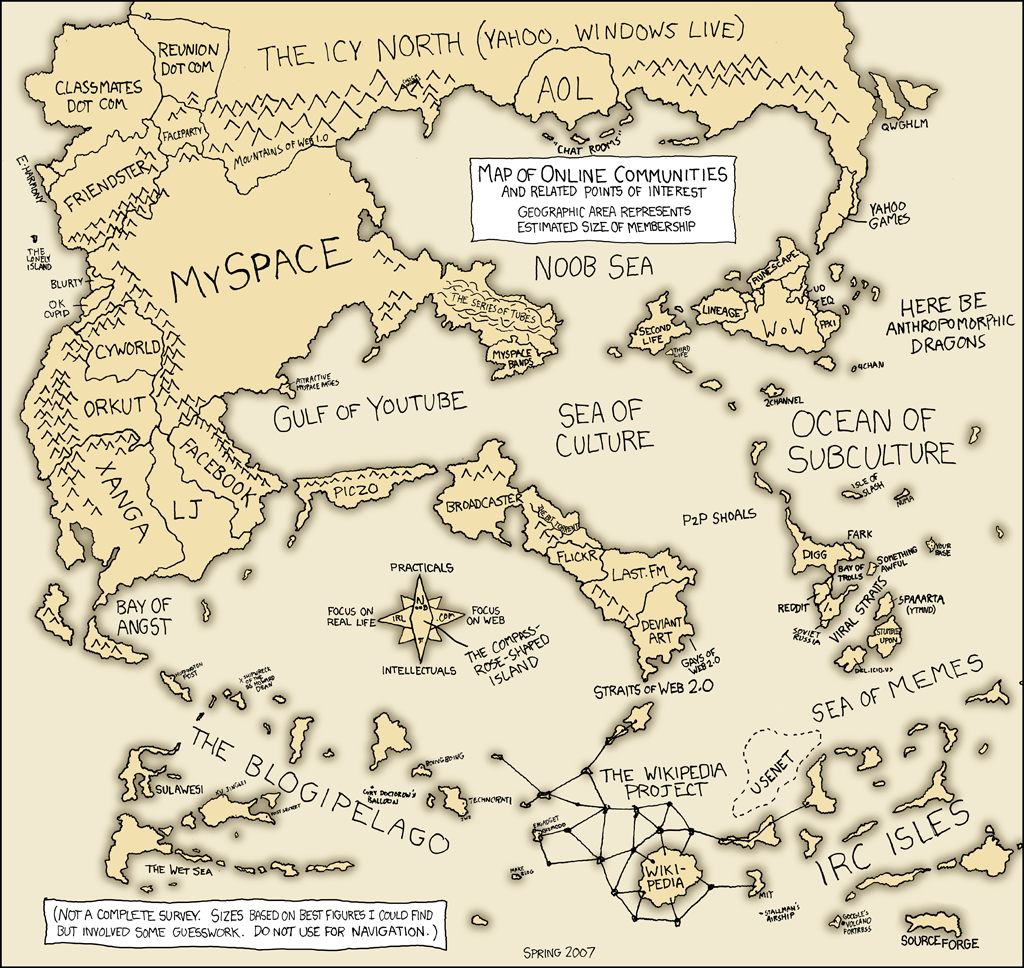
As Benedict Anderson posits in his book, language provided the foundation of nationalism both in Europe and the colonial world. Today, computer coding languages and the internet have enabled a new set of of imagined communities based not on English, or French, or Bahasa, but on html, javascript, perl and the like. These coding languages, much like spoken languages, are inclusive; as long as one invests sufficient energy into learning the code, access is granted to the individual. However, coding takes nationalism one step further. For the first time, the individual envisions himself not only as part of a political entity, or a racial group, or a geographical area; instead, he sees himself as part of and participant in the World Wide Web. Even on the individual level, not only is the individual able to belong, he is also able to modify and change this newly imagined community. Thus, while the internet may be a massive sea of anonymity, it is also an opportunity for the regular person, provided he master the requisite tools, to achieve fame.
Traditional "imagined communities", including the nation, are superimposed on the World Wide Web, and subsequently, on the coding languages that created this space. Simultaneously, code creates new imagined communities while preserving and cementing older ones. Does code aid nationalism, or is nationalism waning in this internet age, as people are able to create worldwide networks based on anything and everything? When Anderson wrote Imagined Communities, Yugoslavia was intact, East Timor was still part of Indonesia, the Soviet Union was still in existence and South Ossetia had not yet declared independence from Georgia. While in the early 1990s, the internet did not have the same capabilities as it does now, the fragmenting of former nations does call into question the direction in which the nation is headed. How do the new languages of the interwebs come into play? Is the current equivalent of print capitalism virtual capitalism?
Jeanine
Jeanine
What would Karl Deutsch say about Internet-English
Karl Wolfgang Deutsch, proud owner of a contemporaneously sinister mustache, was an international relations scholar of rare influence, insight, and impact. Among his works, the one with possibly the most bearing on Imagined Communities must certainly be his long and very nearly always tedious study of 'links' between North America and Western Europe. In an era where telephones were still considered quite vulgar for home use, Deutsch compiled a quite exhaustive collection of practically all forms of trans-Atlantic communication - letters written to families, bills and payments made across Western Union, travelers looking for old London Town, immigrants peering through the fog for Lady Liberty - and with an authority that can only come from some ominous looking books (and not a hastily scribbled blog post) concluded that the two sides of the Pond were getting closer. Not geographically, but through the sheer volume of linkages that each side were shuttling back and forth; a community, if you will, was forming. In a roundabout way, and making some brave theoretical leaps, today scholars may say: hence, NATO or hence, the G-8 or, more grandiosely, hence, the West.

A classic 50s mustache, a tweed suit, and some German-Czech guy.
But today, we have the Internet. Even when factoring in the bandwidth capacity that a typical trans-continental 747 may shift, the raw amounts of data that zoom from point to point on this twinkling globe far outstrips what Karl Deutsch could have imagined (and hence, conspiratorially, Echelon-IV). Literally trillions of dollars flies across these lines of communication on any given week - traders make the world go round. But at the same time, a billion internet kittens purr on screen, a sneezing panda makes squees go off in a thousand slumber parties, porn is streamed one-handedly onto HD monitors, and I watch last night's Daily Show. The Internet promises and, to an extent, delivers an international imagined community on a scale that was impossible even in the grandest of empires.
But unfortunately, that's all also complete and utter bunk.
Information technology does not promise the ideal of free information. We are still constrained by some archaic national boundaries - even online. Hulu does not work outside the United States - it's fine in Buffalo, NY but just wait till you get to Toronto; it's epic fail. Typing in amazon or google.com brings you to different and differently configured websites depending on where you type it in from (or with assistance, dependent on what you set your proxy to). And let's not even begin with that insane DVD-regional coding or some of the more obtuse downloading laws.
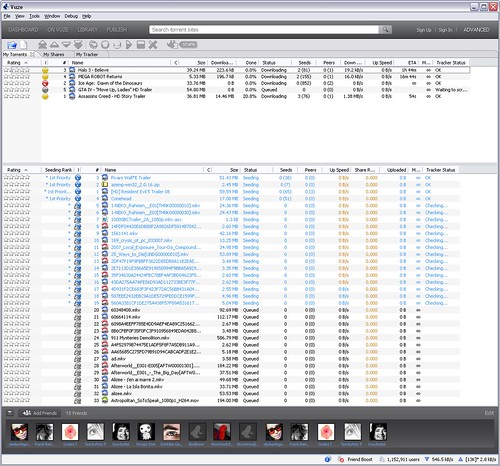
Arrrrr!
One thing, however, does haunt our conception of an internet-international world and that is the pervasive use of English. Out there in the wilds of internetdom, where Russian hackers mingle with Vietnamese WoW-gold farmers, and the occasional out-of-place American college-kid goes to trade information on, the lingua franca (ah-ha) is English - horribly spelled, badly punctuated, and generally lacking any style, but brutally efficient and understandable. This is the language, allegedly, of Shakespeare and Chaucer on a Mexican Spring Break - or to put it another way, English Gone Wild.
But what does this suggest? That English, as a language is international? Yes, we have known that for years. But does that make the users any more international-esque. I somehow doubt it. There is a functional global language and then there's the vernacular. One could make a claim that there will be enough English, in smatters, for a relatively patient young Australian to make-do with a bowl of snarkily-prepared noodles in Xi'An, but English, as transmitted by the Internet, is not a sign that English is on the verge of being a world-conqueror.
And then can be no claims that it puts the UK or the USA in any more a dominant position. They do not own the language the same way that Japan still retains Japanese or that the French hold dying-French. English has become free - a cumbersome way of relieving to another some set of highly pertinent details; a burden to convey what the other would not understand in Urdu/Thai/Finnish. Unlike the "owned" languages of Anderson's proto-nations, English was long ago sacrificed for utility. To suggest that the spread of English is imperial is to make the same accusation of the metric system (run away! meters!).
Karl Deutsch would probably be tickled pink by all of this - if it didn't absolutely bollocks up his findings. Communication, on the internet-plane, is still very much a rich-world affair with most of the information being channeled up and about through the thickest, richest, data cables. But the language that chatters away on it; what a story!
- Aaron Wee
-----------------------
Sadly, this post was devoid of fashion and philosophy. For fashion and philosophy, click here.
Subscribe to:
Posts (Atom)