It's hard not to be excited by the
world presented in Snow Crash – although perhaps that requires a
bit more clarification.
It's hard not to be excited by the
Metaverse, a digital world
(literally) presented via the wonder that is the Internet. Now,
although the Metaverse is something of a unique take on the concept
of a virtual world/life-simulator (at least until one remembers
Second Life, which,
while not extant when Snow Crash
was written, has the distinct advantage of existing now even as the
Metaverse does not), the notion of a digital world that human beings
can interact with, virtually, is not unique.
From Neuromancer to
Ghost in the Shell to
the .hack// games,
there is a very large body of work dedicated to exploring this
concept.
Nevertheless,
the way that Snow Crash
goes about doing it is memorable because of the equal emphasis placed
on the real world.
Granted, a number of other works like this consider real-world
consequences as well (the conceit of the .hack// series
of games/books/tv shows is a virtual MMORPG in which the main
characters are trapped; the new anime Sword Art Online
discusses a world in which
characters are trapped in a different
MMORPG, but their death in-game would result in their death
out-of-game, too).
But
Snow Crash gives
character to its
world; the Metaverse is unlike anything you've ever seen, but so are
the burbclaves and the CosaNostra Pizza, Inc., which couldn't even be
called a “front” for the American mob. It is interesting to note
the parallels between these two worlds. Both focus on real estate
(prime real estate in the Metaverse means being an early adopter and
getting in at the ground floor; in the real world, every suburb is
its own sovereign state), and both emphasize a certain libertarian
ethic: although the corporatization of America has been taken to an
absurd extreme, inside the Metaverse money can still be used to
establish one's status as someone who takes the Metaverse seriously;
and if one is an extremely talented and skilled programmer, like
Hiro, one can use those talents
to increase one's status as well.
It is
an interesting divide; the poor and the idealistic Hiro in the real
world works as the lackey for Uncle Enzo, self-made man of influence,
head of the mafia, essentially the “king of the world”. But in
the Metaverse, he finds not an “escape” from that life; he
becomes a king himself, and others are insignificant before his sword
fighting skills, his intimate knowledge of the world and his own
programs which help him, for instance, dispose of troublesome body
parts left over from said sword fights.
As the
lines between reality and the Metaverse blur (as a piece of code
in-game has direct effects out-of-game) it asks us to think; what
makes the Metaverse any less real, just because one can turn it off?
Hiro's status symbols exist and have meaning to thousands when he is
in the Metaverse; this is not just an identity he puts on and off at
will, however. It is a fundamental part of who he is.
Writing and thinking about Slactivism; at the end of the semester---
I have decided, in posting this post that I missed, not to try and reorient myself back to that week, but to post a retrospective. After writing my paper, I have become very interested in the idea of embedding the past and the future into the contemporary narrative. Let's say trauma as past, desire as future. Berlant, Ahmed, hat's off to you.
So this idea of embedding -- perhaps, conflation, or a reappropriated reconstruction. This, as contrasted by an idea of juxtaposition.
The past event, the Slactivism lab, was (to be frank) slightly traumatic as it occurred in tandem with the opening of my Grandmother's hit Broadway musical. I had to miss this opening.
I will, however, (to look toward the future) be seeing the show in New York on Wednesday. Now to analyze this in the context of desire: why do I want to see this show so badly? Perhaps some idea of feeling "cosmopolitan" ; the agency I have in travelling to New York City for a brief period of time, as an individual, apparently freely acting according to my wishes. And this has to be combined in some manner with the idea that I should make my Grandmother happy and also proud. I call this grandmother Mumu. Visiting Mumu is always a performance of sorts, more so than another engagement as she often performs me. I am her granddaughter, young and fresh, a senior at Brown University. I offer some notion of potential which I like to play. I want to play. I hope that I will successfully play, successfully enact in an effort to promote its fruition. I want to have had potential and to represent the manifestation of such -- some notion of a future success.
SO: the current narrative; this blog post. Slactivism. Is Slacktivism ever a manifestation of success? What is success, how will I one day feel morally sound, with a heart that is happy and full. There was an article I remember a few years ago about the obsession with "happiness" in American culture. Perhaps the American Dream has now been translated to some desire to be happy. A state of being as the number one desire, one degree further from manifestations of fantasies of what might make one happy. Is this progress, this distillation of meconaissance into emotion?
The lab itself was a success -- we caused patrons and employees of Brown's Rockafeller Library to question our actions in the context of revolt. Is this success? We had no intentions of actual revolt. However, to spark thought and dialogue seems like it must be a success.
Here I find the success and failure of Kony all tied together.
Kony sparked dialogue. Kony also incited action -- but perhaps not either a sustainable or even a useful form of action. And yet, here I am writing about Slactivism and happiness and what I want for my future and I think to reference Kony. So, it provides an outlet, or better yet-- a base, from which to talk about activism on the internet.
Its an interesting time, again, to talk about success and failure in terms of the internet now that Egypt has AGAIN witnessed revolt. And there was a shooting in Connecticut which made President Obama cry on national news. There was this question about engagement in political thought in tandem with these shootings-- too early? too late? What is respectful in terms of channelling a tragedy so quickly into motivation for political discourse...? My thoughts run wild all over the place when thinking about such issues.
And maybe that's okay... thoughts all over the place, all inhabiting this present space of what is now. A spatio-temporal space that is infinitely deep, infinitely related, impossible to navigate but always necessarily reorienting itself inwardly to channel the myriad possibilities that may or may not manifest in full.
Because I was studying abroad when Kony hit it big, I did not watch the first Kony video that went viral in real time, and only heard bits and pieces of the viral response and ultimate self-destruction of the founder. However, the video is called Kony 2012, and threatens to expire at the end of this year, so revisiting it and the the follow-up, with tactical planning for the rest of the calendar year, seemed timely.
The Kony campaign has made a resurgence in the news, but it is for the amount of views generated, not the impact of the effort. In the Google Zeitgeist results, it is a top viewed documentary, but its exceptional-ness is currently outshined by the similarly inexplicable rise of Gangnam Style. How can the disconnect between awareness and action be further proved than this?
I have continued to think about Professor Muhanna's closing statement, about how in an age of increasingly sophisticated arguments, one must not need to argue an accurate, but rather a sophisticated argument, in order to be correct. Given the high volume of information and possible explanations to any situation, decision making and power will continue to lie in the lo-fo power of charisma and other affective persuasion.
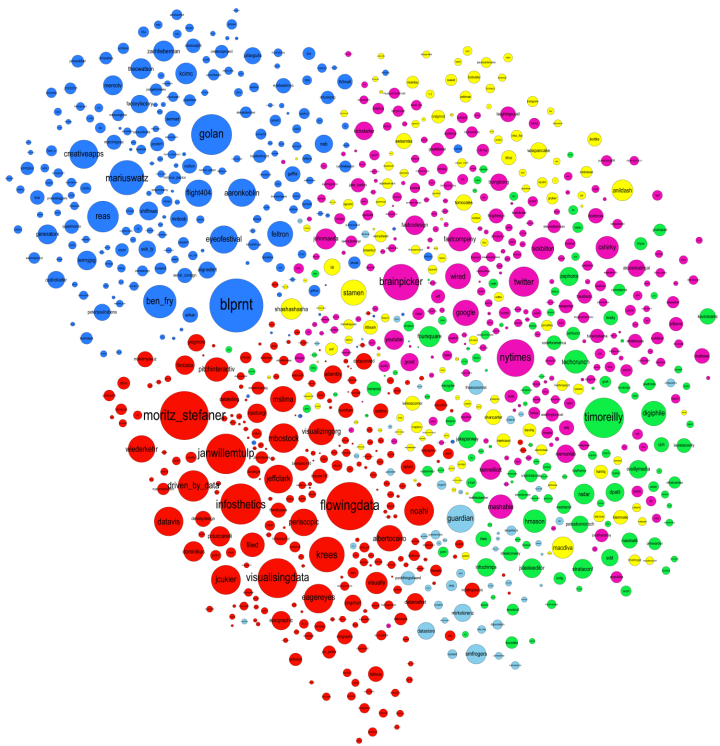
After Professor Muhanna's lecture, we were forwarded a link to the map of the Arabic blogosphere in 2009, which I believe was trying to say something about the density, frequency, or prevalence of certain factors in that community. It's really not clear to me now what I should have gotten out of that chart, or even why the image exists.
Ultimately, I think the simplicity and simultaneous complexity of this image is attempting to tell me that the information in it is important - without anything districting in the details, the ur-relationships of the blogosphere must become apparent. Just as Muhanna had referenced the volume of video footage with confusing meaning, this exercise in restraint does the same thing. It is persuasuve without informing. It is also so ambiguous that it could be describing anything: like renewable energy genes (image 1) or data viz subgroups themselves (image 2). I think Muhanna reinforced in practice that the desire for mapping, as described by Jameson in the first weeks of our course, is still very much an unanswered need. How can we understand the world without reducing it down to circles?
Humanitarian work has undoubtedly surpassed the realm of NGO’s and
international institutions like Oxfam or UNICEF. In fact, Didier Fassin writes
that since the late 20th century, a growing number of private groups
have emerged to head humanitarian work and fundraising efforts (Fassin 6). The
private sphere has increasingly concerned itself with issues of poverty,
disease, and the act of helping those less fortunate; in part due to the
increasing number of celebrities that are dedicating themselves to causes in
order to cast humanitarian work into a different, more attractive light. In
particular, U2 front man Bono’s venture, Product (RED), was created in 2006 in
order to raise money for The Global Fund, a financer of programs fighting AIDS,
malaria, and tuberculosis (Pont 711).This paper will aim to use (RED) as a case study to explore the use of
celebrity and elite brands in advertising for humanitarian organizations, and
how the goal of driving consumption skews not only the consumer’s perception of
the issue and their contribution towards it, but also the altruistic objective
of humanitarian aid. Using both Sarah Ahmed’s language of pain and love and
Fassin’s discussion of the appropriation of ‘suffering’ in the new humanitarian
world order as a framework reveals that private organizations like (RED) use
celebrities to glorify humanitarian aid organizations and work. In the course
of promoting cause-driven consumption, (RED) perpetuates relations of
inequality with the alluring promise to consumers of the attainment of an
ideal, thereby largely negating any true acts of morality or altruism.
I noticed recently that when I googled "National Anthem Lyrics" the top results were divided, fairly evenly, between results relating to the "real" National Anthem ("The Star Spangled Banner") and Lana del Rey's 2012 pop song "National Anthem."
Below is Lana Del Rey's 2012 Official Music Video "National Anthem." The music video
depicts del Rey in a contemporary reinterpretation of the John F. Kennedy era, particularly focused on the tragedy of 1963. I am interested in the reproduction of the national tragedy of the mid-twentieth century, as it exists within the lexicon of twenty-first century desire.
In "National Anthem" Lana del Rey begins with a rendition of Marylyn Monroe's iconic "Happy Birthday Mr. President" performance.
Within the seven minute film, Lana del Rey plays the role of both Jackie Kennedy and also Maryln Monroe, interacting with the figure of "JKF" in a somewhat interchangable manner. The final scenes of the film depict a reproduction of the presidential assasination. (Below the images of the Lana del Rey version I have included still from the Zapruder film of the actual assasination).
My focus on Lana del Rey's contemporary reinterpretation of the JFK scandle is driven by four main points of interest: the actual national tragedy of 1963, along with the public response it provoked; the public interest in the personal relations caused by the triad of President Kennedy, Jackie Kennedy, and Maryln Monroe; the function of a contemporary reinterpretation of the respective issues in a pop-culture setting; and the implicit narrative of titling this interpretation "National Anthem."
My final paper will look at these points as the relate to Lauren Berlant's "Critical Optimism," Sarah Ahmed's "The Politics of Emotion," and Benedict Anderson's "Imagined Networks."
Within the scope of these three authors, I hope to explore the relationship between desire and identity, translated from the political body to the indivual. I am curious how the wound of a nation translates to the sorrow of an individual, and vice-versa. Furthermore, I am interested in the fascination with the romanticism of the mid-twentieth century national wound, as it exists in a discoure of nastalgia apart from such a wound today. I believe this nastalgia is related to the idea of an "American Dream," as discussed by Berlant -- as it exists within a national identity (Anderson). This romantic nastalgia suggests that similar crises today could not offer the same affective logic to a viewer-- for example, the Monica Lewinski scandle with President Clinton, or otherwise the the national tragedy of September 11, 2001. Moreover, what is at stake in linking lust (by way of the JFK-Monroe scandle; with desire, perhaps even fantasy) and pain (the national wound; a scar, perhaps as a disruption to the habitual)? Ahmed writes about the power of the scar, as it marks the existence of history in the quotidinal present; however, aside from the gun shot and the concern on del Rey's face, the music video "National Anthem" is devoid of the violece inherent in the reference to the assasination. Furthermore, in synthesizing the characters of Monroe and Kennedy into a single person, an individual within the historical narrative, the music video similarly eradicated the pain inherent in the duplicity of these relationships to JFK.
My paper thus demands an answer regarding the function-- perhaps the utitlity (or its inverse)-- of the over 10.5 million views of the official youtube video of Lana del Rey since it was posted five months ago, 27 June 2012.
The structure of the paper, as I envision it, should go as follows:
Introduction
Presentation of the main idea:
Earlier this year, Lana Del Rey produced a widely received single titled "National Anthem," with a music video that depicts a representation of the Kennedy presidency through the eyes of a single woman (Del Rey), here designed to embody both Jackie Kennedy and Maryln Monroe.
The prominent themes to be discussed: (answering the general question-- why this, why now?) -violence & a national wound -- why JFK's assasination, and not 9/11 -nastalgia & the american dream -- why has this national obsession held up through the test of time -fantasy & desire -- what is at stake in Del Rey's embodiement of these two women; what is the meaning of their conflation to the identity of the contemporary woman
Main question(s): Does the re-presentation of the Kennedy era in "National Anthem," devoid of pain or trauma, function as an incorporation of the memory of pain in the body politic, as a "scar" to mark the memory of a wound; or conversely, does the apathetic incorporation of trauma into the pop-culture dialectic further divorce the event from its place in the political consciousness, thereby allowing the original disruption to flow more smoothly into the neoliberal capitalist agenda that determines the contemporary democratic body?
Working Thesis:
an answer to the question or perahaps simply the question itself.
Conclusion
In MTV's interview with Anthony Mandler, the director of "National Anthem," Mandler is described as feeling that, "the video is less about reinterpreting history and as it is about
examining loss, historical or otherwise." Mandler says,"The whole movie kind of hedges on the gunshot, it hedges on that close-up of
the hand when the gunshot happens, and you don't see anything violent. What
you're used to seeing with the Zapruder film, is this very kind of violent,
destructive act; I didn't want to go anywhere near that."
---
What is at stake in the reappropriation of a national anthem within the context of contemporary popular culture's dialectic of erotic desire? In a recent article in Artforum titled "This Year in Pop," Christopher Glazek ends by saying:
"Del Rey is not a political singer, whatever that could mean in 2012, but her songs and videos trade on, or perhaps consume, the great issues of our day. Del Rey is a fantasist, too, but her fantasies are worldly and ambitious. Her vision, while affirmative, is also unblinkered; through it, she brings a rare candor to an escapist enterprise. She allows us to escape, but to escape into reality, and thereby perhaps to remake it."
Glazek's article focuses primarily on Lana Del Rey's 2012 hit song "National Anthem" (Born to Die, Interscope), as the song, and its accompanying video, reinterpret the scandle and tragedy of the John F. Kennedy presidency in the context of the contemporary post-modern dialectic of desire. Lana del Rey's contemporary reinterpretation of the Kennedy era enacts the relationship between desire and identity, translated from the political body to the indivual. There is a certain gravity to the video re-presentation of the Kennedy assasination, as it manifests devoid of any of the violence of the murder. In an MTV interview with Anthony Mandler, the director of "National Anthem," Mandler is described as feeling that, "the video is less about reinterpreting history and as it is about examining loss, historical or otherwise." Mandler goes on to say:
"The whole movie kind of hedges on the gunshot, it hedges on that close-up of the hand when the gunshot happens, and you don't see anything violent. What you're used to seeing with the Zapruder film, is this very kind of violent, destructive act; I didn't want to go anywhere near that."
This interest in loss apart from violence also seems to manifest in the decision to renarrativise the history of the triadic relations between President Kennedy, Jackie Kennedy, and Maryln Monroe. The depiction of the Kennedy presidency through the eyes of a single woman (Del Rey), here designed to embody both Jackie Kennedy and Maryln Monroe. This synthesis of the sovergneity of Monroe and Jackie Kennedy into a single person, an individual within the historical narrative, eradicates the inherent pain present in the duplicity of these relationships to the president. Here there is, on the one hand, a confusion of lust (by way of the JFK-Monroe scandle) and pain (the national wound); while simultaneously a conflation of the lust and pain that manifests on a more general register, in the relation of the reinterpretation to the original events. It finally seems relevent that this reappropriation of historical events exists under the title "National Anthem." The title itself thereby presents an argument regarding the content of the music video as it relates to the production of national identity. The function of this production, however, is less clear: does the re-presentation of the Kennedy era in "National Anthem," devoid of pain or trauma, function as an incorporation of the memory of pain in the body politic, as a "scar" to mark the memory of a wound?; or conversely, does the apathetic incorporation of trauma into the pop-culture dialectic further divorce the event from its place in the political consciousness, thereby allowing the original disruption to flow more smoothly into the neoliberal capitalist agenda that determines the contemporary democratic body?
Ahmed writes about the power of the scar, as it marks the existence of history in the quotidinal present; however, aside from the gun shot and the concern on del Rey's face, the music video "National Anthem" is devoid of the violece inherent in the reference to the assasination. Furthermore, in
; a scar, perhaps as a disruption to the habitual
the function of a contemporary reinterpretation of the respective issues in a pop-culture setting; and the implicit narrative of titling this interpretation "National Anthem."
My final paper will look at these points as the relate to Lauren Berlant's "Critical Optimism," Sarah Ahmed's "The Politics of Emotion," and Benedict Anderson's "Imagined Networks."
Within the scope of these three authors, I hope to explore I am curious how the wound of a nation translates to the sorrow of an individual, and vice-versa. Furthermore, I am interested in the fascination with the romanticism of the mid-twentieth century national wound, as it exists in a discoure of nastalgia apart from such a wound today. I believe this nastalgia is related to the idea of an "American Dream," as discussed by Berlant -- as it exists within a national identity (Anderson). This romantic nastalgia suggests that similar crises today could not offer the same affective logic to a viewer-- for example, the Monica Lewinski scandle with President Clinton, or otherwise the the national tragedy of September 11, 2001. Moreover,